USC Stevens Neuroimaging and Informatics Institute
Researcher
Apr 2026 — Present
Marina del Rey, CA · Remote
Two research projects so far, both on 3D T1 MRI — one on optimizer generalization, one on multi-site harmonization.
M.S. Computer Science @ USC
I work on machine learning systems that have to hold up outside the benchmark — real-time vision in production, multi-agent LLM reliability, and the research into why models generalize at all.
Each one links to a short case study: the problem, the decisions, and what the numbers looked like afterward.
Open to SWE and ML engineering roles
Say helloFour roles, mostly computer vision under real-world constraints — what I built, what it measured, and the calls I had to defend.
Researcher
Apr 2026 — Present
Marina del Rey, CA · Remote
Two research projects so far, both on 3D T1 MRI — one on optimizer generalization, one on multi-site harmonization.
Software Engineering Intern
Jan 2025 — Jun 2025
Bengaluru, India · Remote
Owned the detection side of a retail loss-prevention product — shoplifting and age detection across stores that looked nothing like each other.
Add pose estimation on top of object detection over tune the detector harder
Concealment is defined by what the body does, not by what's in the frame. A bounding box around a person and a product can't distinguish picking an item up from hiding it — keypoint dynamics can.
Trade-offA second model in the pipeline, which costs inference time on every frame that contains a person.
Sequence models (YOLO-LSTM, RCNN-LSTM) over per-frame classification
Shoplifting is an action, and an action only exists across frames. Per-frame scoring fires on any single ambiguous posture, which is exactly where the false positives were coming from.
Trade-offNeeds temporally labelled data and a buffer of frames before it can decide, so alerts arrive later.
Academic Intern
Dec 2023 — Jan 2024
Singapore · On-site
Led six people building a lane violation detector that had to run on live traffic footage, end to end, in two months.
Build a custom dataset from public traffic footage over an off-the-shelf traffic dataset
Lane violations are defined by local road markings and driving conventions. A model trained on someone else's roads learns the wrong geometry.
Trade-offWeeks of scraping and annotation before a single model could be trained.
Benchmark five architectures before committing over start with the obvious YOLOv7 baseline
Real-time was a hard requirement, so the choice had to be made on the accuracy-versus-latency curve for this data — not on published numbers from a different benchmark. YOLO-NAS won and shipped.
Trade-offSpent early project time on evaluation instead of building.
Streamlit and Vercel for the frontend over a custom web application
The deliverable was a working demonstration on a two-month clock. The interface needed to exist and be shareable, not to be bespoke.
Trade-offNot the deployment you'd choose for real production traffic.
Data Science Intern
Aug 2023 — Oct 2023
Bengaluru, India · Remote
Built cashier theft detection into a live CCTV pipeline, and worked out what it would cost to run the models at the edge.
Post-training quantization over quantization-aware training
QAT means retraining, and the detection models had already been trained on millions of labelled images. Redoing all of that to recover a few points of post-quantization accuracy was not a trade worth making.
Trade-offPTQ gives up more accuracy than QAT, so the retention-versus-latency curve had to be measured and documented rather than assumed.
Port YOLO-NAS's quantization block into YOLOv7 over migrate production to YOLO-NAS
YOLO-NAS ships a quantization-friendly block that YOLOv7 doesn't have, but production was already running on v7. Transplanting the block keeps the existing weights and pipeline intact; switching architectures would have meant retraining and revalidating the whole detection stack.
Trade-offImplementing a block on an architecture it wasn't designed for — more integration work, and no guarantee the quantization gains carry over.
Peer-reviewed work in time-series forecasting, materials property prediction, and applied IoT.
T. Sidhaarth, P. A. Obla, N. N. Patil, Z. Stamenković, S. P. Raja
Journal of Circuits, Systems and Computers · 34(12), 2530006 · 2025
T. Sidhaarth, P. A. Obla, L. Ramasamy, S. K. Selvaraj
Journal of Mechanical Science and Technology · 40(2), 997–1006 · 2026
P. A. Obla, A. Kaushik, M. Santosh, N. R. D'Souza, A. Suresh
Artificial Intelligence: Theory and Applications — Proceedings of AITA 2025 · pp. 281 · 2026
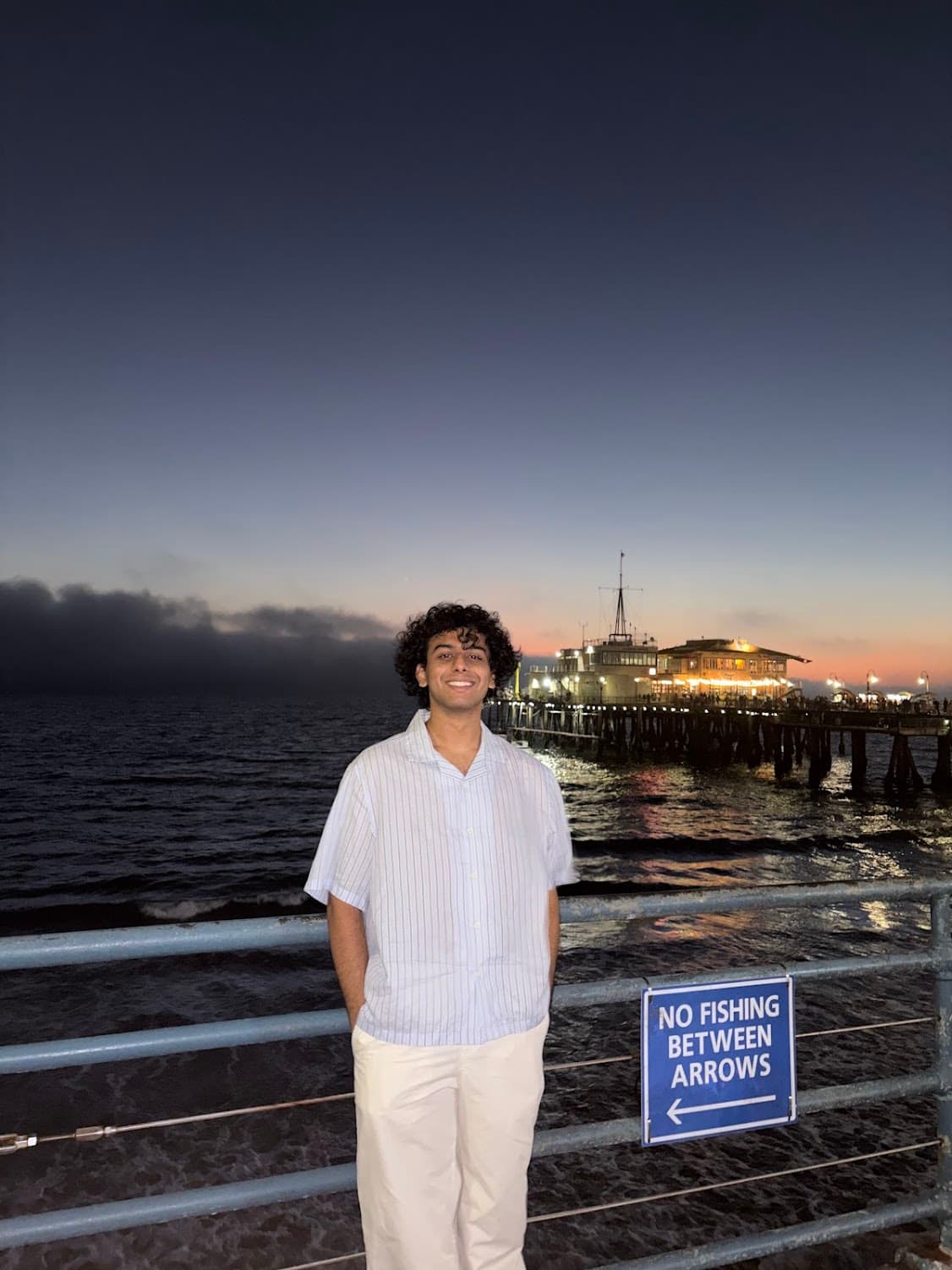
I'm a computer science master's student at USC. My work runs from real-time computer vision in production to LLM reliability to the optimization theory underneath both — but it's all the same question: what happens to a model once it leaves the benchmark it was tuned on.
That question is more interesting than it sounds. A detector at 90% on a clean test set and 60% on a store's CCTV feed isn't a good model, it's an unfinished one. Two models that score identically can behave completely differently when one audits the other. And an optimizer that trains faster may not generalize better at all — which is what I found when I decomposed Muon and reported the null result.
Outside of that: [one genuine interest — this is the line an interviewer remembers you by].
University of Southern California
M.S. Computer Science
Aug 2025 — May 20273.40 / 4.00
Focus: deep learning, NLP, and agentic AI
6 coursesVellore Institute of Technology
B.Tech Computer Science and Engineering
Minor in Business Systems
Sep 2021 — May 20259.12 / 10.00
41 coursesGrouped by what it's for rather than by how well I know it — the experience and project sections show where each one was actually used.
I read every message. If you're hiring, collaborating, or just want to argue about database internals, my inbox is open.
oblaanan@usc.edu